A Short History of San Francisco by Tom Cole
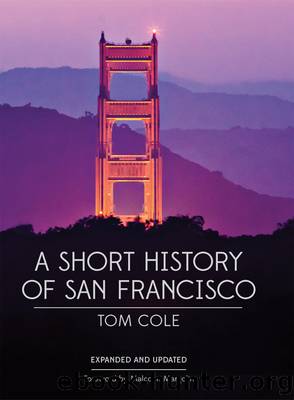
Author:Tom Cole [Cole, Tom]
Language: eng
Format: epub
Published: 0101-01-01T00:00:00+00:00
GOOD TIMES IN BAD
San Francisco has always been a city buffeted by the unexpected. But even in the worst of times it scarcely lets up in its âintensified pursuit of human happiness.â So, in its years of economic decline, following the disappointment of the railway, and in the decades following, when it regained its monetary muscle and strode confidently toward a new century, San Francisco kept right on polishing its reputation for excitement and devotion to lifeâs finer things.
âThe climate of California deals kindly with excess,â wrote visiting Rudyard Kipling. He found San Francisco âa mad city, inhabited for the most part by perfectly insane people whose women are of a remarkable beauty.â San Francisco society had a âcaptivating rush and whirl. Recklessness is in the air.â
This was the age of the free lunch, when, wrote Kipling, âYou paid for a drink and you got as much as you wanted to eatâ¦For something under a rupee a day a man can feed himself sumptuously even though he be bankrupt.â All evidence points to quite a few who spent more than a rupee. âThe native pours his vanity into himself at unholy hours,â Kipling wrote. âDrinking is more than an institution, it is a religion.â
If drinking was a religion, there was ample opportunity to practice. From the fabulous Palace Bar, with its troop of solicitous tenders, to the surreal Cobweb Palace on Meiggâs Wharf, where a patron might share his drink with a half-tame monkey, the town housed an amazing number and variety of taverns and eateries.
San Franciscans thronged to Mayes Oyster House for Eastern oysters and fresh fish (and still do). âLuckyâ Baldwinâs Hotel at Powell and Market, with its $25,000 lobby clock and its posh dining room, was a rival of the Palace. Less fancy was the What Cheer House, a gustatory celebration of the American virtues of simplicity and quantity. The Fior DâItalia was (and still is) a favorite of the Italian community. In not a few of San Franciscoâs restaurants, the well-heeled diner could retire upstairs with a bottle of vintage bubbly and perhaps enjoy a high-stakes poker game or the company of a delightful young lady âfrom the finest Eastern finishing school.â
At night, Kearny Street was a genteel thoroughfare of light and color, its restaurants and bars filled, its pavement delicately trodden by the ladies who so impressed Rudyard Kipling. Barely out of sight of Kearny Streetâs âlarge-boned, deep-chested, delicate-handed women, and long, elastic, well-built boysââSan Franciscoâs middle classesâwas Morton Street (now chaste Maiden Lane), an alley of cut-rate depravity ruled by one Iodoform Kate.
On weekends, San Franciscans visited one of the cityâs many beer halls, took refreshment and admired the seals from the Cliff House, or made family outings to the new park. A favorite of all ages was spectacular Woodwardâs Gardens, a pre-Disneyland extravaganza of gardens, exotic animals, rides, and uplifting art exhibits, owned by the What Cheer Houseâs Robert Woodward. Woodwardâs Gardens, located at Mission and 14th Street, was a San Francisco landmark until 1883.
Download
This site does not store any files on its server. We only index and link to content provided by other sites. Please contact the content providers to delete copyright contents if any and email us, we'll remove relevant links or contents immediately.
| Africa | Americas |
| Arctic & Antarctica | Asia |
| Australia & Oceania | Europe |
| Middle East | Russia |
| United States | World |
| Ancient Civilizations | Military |
| Historical Study & Educational Resources |
The Dawn of Everything by David Graeber & David Wengrow(1717)
The Bomber Mafia by Malcolm Gladwell(1633)
Facing the Mountain by Daniel James Brown(1562)
Submerged Prehistory by Benjamin Jonathan; & Clive Bonsall & Catriona Pickard & Anders Fischer(1460)
Wandering in Strange Lands by Morgan Jerkins(1436)
Tip Top by Bill James(1420)
Driving While Brown: Sheriff Joe Arpaio Versus the Latino Resistance by Terry Greene Sterling & Jude Joffe-Block(1380)
Red Roulette : An Insider's Story of Wealth, Power, Corruption, and Vengeance in Today's China (9781982156176) by Shum Desmond(1364)
Evil Geniuses: The Unmaking of America: A Recent History by Kurt Andersen(1359)
The Way of Fire and Ice: The Living Tradition of Norse Paganism by Ryan Smith(1342)
American Kompromat by Craig Unger(1327)
F*cking History by The Captain(1312)
It Was All a Lie by Stuart Stevens;(1306)
American Dreams by Unknown(1294)
Treasure Islands: Tax Havens and the Men who Stole the World by Nicholas Shaxson(1278)
Evil Geniuses by Kurt Andersen(1262)
White House Inc. by Dan Alexander(1219)
The First Conspiracy by Brad Meltzer & Josh Mensch(1179)
The Fifteen Biggest Lies about the Economy: And Everything Else the Right Doesn't Want You to Know about Taxes, Jobs, and Corporate America by Joshua Holland(1128)
